If you work anywhere near a CNC lathe, you’ve handled these three inserts. They look almost identical in a drawer, but each one is built for a different job. Confusing them can mean poor surface finish, broken edges, or a tool that simply can’t cut the way you need it to.
In this guide, we’ll break down DNMG, VNMG, and VBMT inserts — what their names actually mean, how their shape and relief angles differ, and which one to reach for depending on your operation.
How to Read an Insert Code (ISO Designation)
Every carbide insert has a code like DNMG, VNMG, or VBMT. This isn’t random — it’s an internationally standardized system (ISO 1832) where each letter/number position tells you something specific:
| Position | What It Tells You | Example |
|---|---|---|
| 1st letter | Insert shape | D, V, C, S, T, R |
| 2nd letter | Relief (clearance) angle | N, B, A, C, P |
| 3rd letter | Tolerance class | M, G |
| 4th letter | Hole & chipbreaker type | G, T, M, N |
Shape Angle: D vs V — Are They Really the Same?
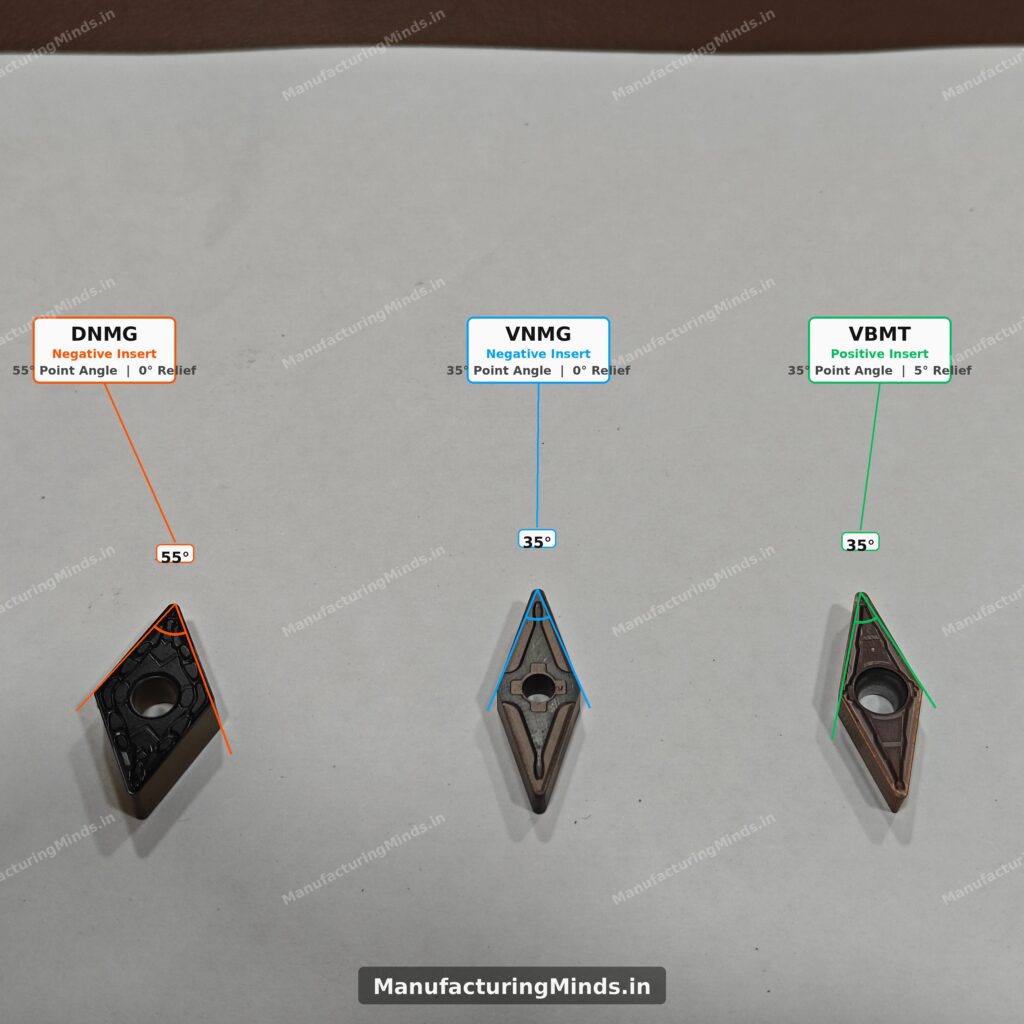
- D = 55° diamond (rhombic) shape
- V = 35° diamond (rhombic) shape
DNMG has a different point angle (55°) than VNMG and VBMT (35°). But VNMG and VBMT share the exact same shape angle — both are 35° diamond inserts. Their difference isn’t the shape at all; it’s the relief angle.
Why does the point angle matter?
- 55° (D-shape): Wider, stronger point angle. Resists chipping, handles heavier depths of cut and interrupted cuts.
- 35° (V-shape): Sharper, narrower point angle. More versatile for profiling and tight corners, but weaker at the tip — lower feed/DOC than a D-shape.
Relief Angle: The Real Difference Between VNMG and VBMT
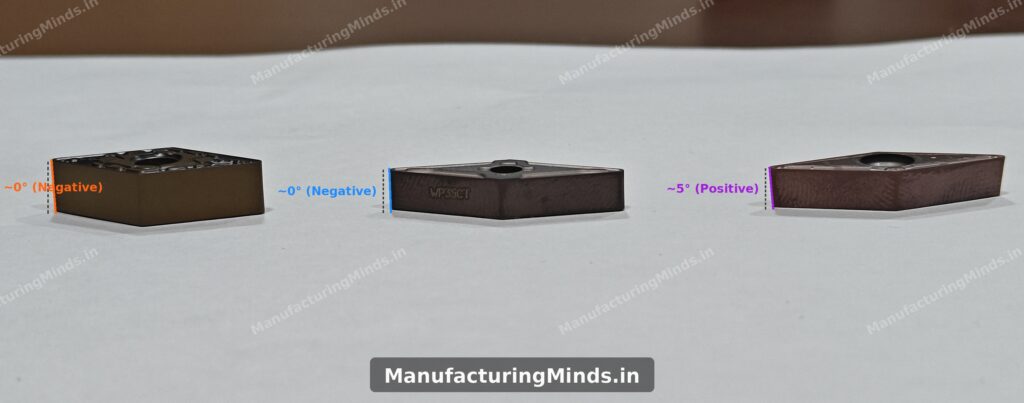
- N = 0° relief angle → a “neutral” or negative insert
- B = 5° relief angle → a positive insert
| Insert | Shape Angle | Relief Angle | Insert Type |
|---|---|---|---|
| DNMG | 55° (D) | 0° (N) | Negative |
| VNMG | 35° (V) | 0° (N) | Negative |
| VBMT | 35° (V) | 5° (B) | Positive |
VNMG and VBMT share the same 35° point angle, but VNMG has zero relief (negative geometry) while VBMT has a 5° built-in relief (positive geometry). DNMG and VNMG both being “N” type means they’re both negative inserts — even though their shapes (D vs V) differ.
Negative Inserts (DNMG & VNMG): Pros and Cons
Pros:
- Double-sided — usable on both faces, roughly doubling edges per insert
- Stronger cutting edge — handles heavier feeds, roughing, and interrupted cuts
- More economical for high-volume roughing
Cons:
- Higher cutting forces and heat generation
- Needs a rigid machine/workholding
- Not ideal for fine finishing or delicate parts
- Requires a negative-rake toolholder
Positive Inserts (VBMT): Pros and Cons
Pros:
- Lower cutting forces — shears rather than pushes into material
- Better for finishing, thin-walled parts, and less rigid setups
- Better chip control at light feeds
- Great for internal boring where clearance matters
Cons:
- Single-sided only — half the edges of an equivalent negative insert
- Weaker edge support — not for heavy roughing or interrupted cuts
- More prone to chipping if pushed hard
| Feature | DNMG | VNMG | VBMT |
|---|---|---|---|
| Shape | 55° Diamond | 35° Diamond | 35° Diamond |
| Relief Angle | 0° (Negative) | 0° (Negative) | 5° (Positive) |
| Sides Usable | Double-sided | Double-sided | Single-sided |
| Edge Strength | Very High | Moderate-High | Moderate |
| Cutting Force | Higher | Higher | Lower |
| Best For | Heavy roughing | General turning/facing | Finishing, boring, thin-wall |
Which Insert Should You Choose?
- DNMG — max edge strength, heavy roughing, rigid lathe
- VNMG — negative, double-sided, but sharper 35° point for better corner access
- VBMT — finishing, thin-walled parts, boring, lower-powered machines
FAQ
Is VNMG the same shape as VBMT?
Yes — both 35° diamond inserts. The difference is relief angle: VNMG is 0°, VBMT is 5°.
Why is DNMG stronger than VNMG?
DNMG’s 55° point puts more carbide behind the edge versus VNMG’s 35°, resisting chipping under heavy loads.
Can VBMT be used for roughing?
Not recommended — it’s built for finishing and light-to-medium cuts, not aggressive stock removal.
Do negative inserts need a special toolholder?
Yes — the toolholder provides the clearance angle by tilting the insert, since the insert itself has 0° relief.
Getting comfortable with insert codes pays off fast on the shop floor. Once you can glance at “DNMG,” “VNMG,” or “VBMT” and immediately know the point angle, the relief geometry, and whether it’s negative or positive — you’ll pick the right insert on the first try instead of the third.
To recap: DNMG gives you the strongest edge for heavy roughing, VNMG balances strength with better corner access, and VBMT trades edge count for lower cutting force and a cleaner finish. None of these is “better” — they’re built for different jobs, and knowing which is which is what separates guesswork from good machining practice.
If this comparison helped clear things up, share it with someone still mixing up their inserts, and drop a comment below if you’d like us to break down other insert families the same way.
© 2026 Manufacturing Minds Precision LLP. All rights reserved. This content may not be reproduced without permission.