
If you work anywhere near a lathe, you’ve probably noticed that tool holders aren’t labeled with friendly names like “finishing holder” or “roughing bar.” Instead, you get strings like EWLNR-2525M08 or PDJNL-2525M15 — a jumble of letters and numbers that actually tells you everything about the tool, once you know how to read it.
In this guide, we’ll break down what a CNC tool holder is, why the ISO naming system matters, and walk through three real holders — EWLNR-2525M08, PDJNL-2525M15, and DVJNL-2525M16 — as worked examples so the code stops looking like alphabet soup.
What is a CNC Tool Holder?
A CNC tool holder is the fixture that clamps a cutting insert (or a solid cutting tool) and mounts it securely to the machine — typically the turret of a CNC lathe or the tool post of a manual lathe. Its job sounds simple: hold the insert rigidly, at the right angle, so the cutting edge meets the workpiece exactly where the program expects it to.
In practice, the holder does a lot of quiet, critical work:
- Rigidity — absorbs cutting forces without deflecting, which directly affects surface finish and tool life
- Repeatable positioning — every insert index or replacement returns to the same location within microns
- Insert clamping — secures the carbide (or ceramic/CBN) insert without cracking it or letting it shift under load
- Coolant delivery — many modern holders route coolant directly to the cutting edge
A poorly chosen or worn-out holder shows up as chatter, poor finish, premature insert wear, or inconsistent part dimensions — problems that often get blamed on the insert or the machine when the holder is actually the culprit.
Why the ISO Designation System Matters
Every major manufacturer — Sandvik, Kennametal, Iscar, Mitsubishi, Seco, Tungaloy, Widia — follows the same ISO naming convention for turning tool holders. That’s genuinely useful: once you can read the code, you can walk into any tooling catalog in the world and know exactly what you’re looking at, regardless of brand.
For external turning holders, the code generally breaks down into these positions:
- Clamping method — how the insert is secured (top clamp, lever/hole clamp, screw, wedge, etc.)
- Insert shape — the geometry of the cutting insert (diamond, trigon, square, round, etc.)
- Holder style / entering angle — the approach angle the tool takes into the workpiece
- Insert clearance angle — the relief angle ground into the insert
- Hand of the tool — right-hand (R), left-hand (L), or neutral (N) 6–7. Shank height and width — the physical shank size in mm
- Overall length code — indicates the holder’s length series
Once you know this pattern, any holder code becomes readable at a glance. Let’s apply it to three holders you’ll commonly see on a shop floor.
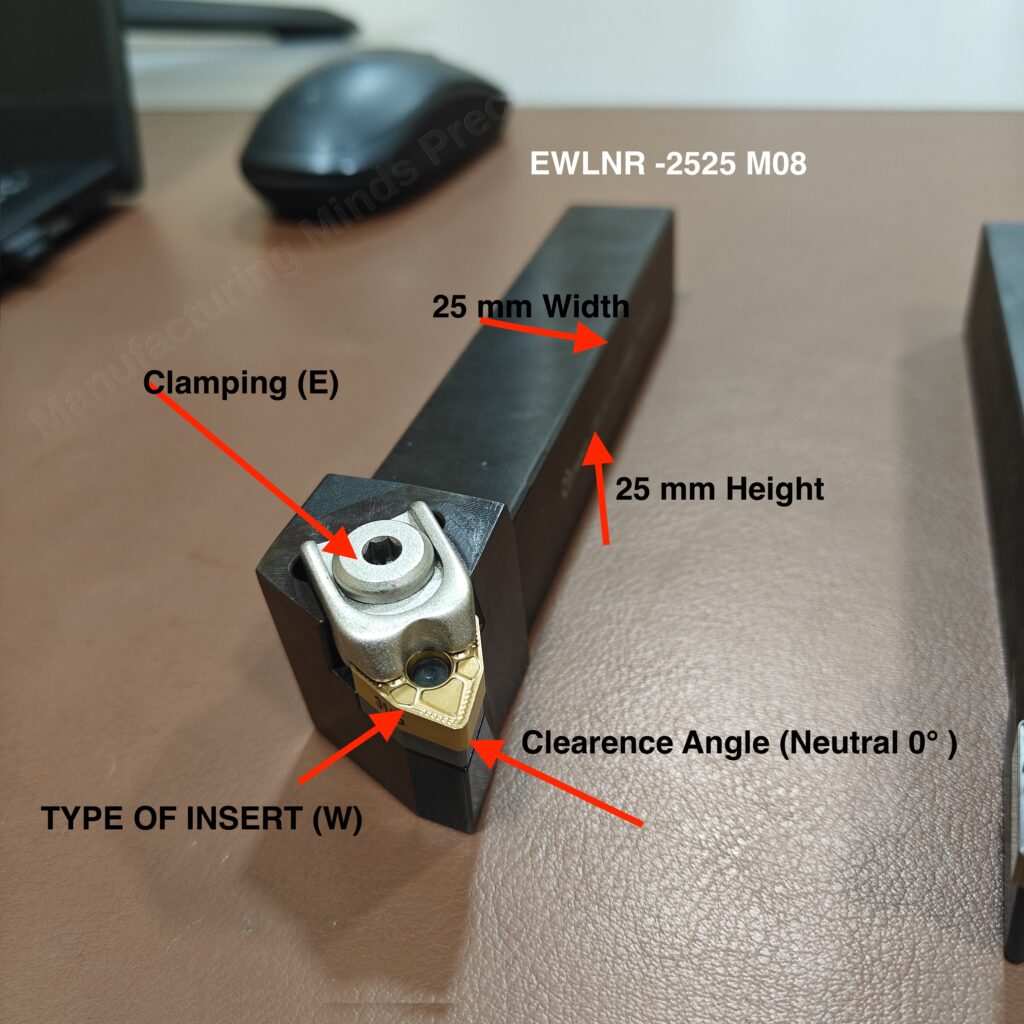
Example 1: EWLNR-2525M08
- E — Top-clamping method, used for inserts without a center hole
- W — Trigon insert shape (a three-sided, 80° insert)
- L — Holder style with a 95° entering angle
- N — 0° insert clearance angle (negative-style insert)
- R — Right-hand orientation
- 25×25 — Shank height and width in mm (square shank)
- M08 — Length code for this holder series
What it’s good for: The Trigon insert gives you three usable cutting edges per side (six total with a two-sided insert), which stretches insert life across a job. The 95° entering angle makes this a versatile holder for both general turning and light facing work, and the right-hand orientation means it cuts moving from right to left on a standard lathe setup.
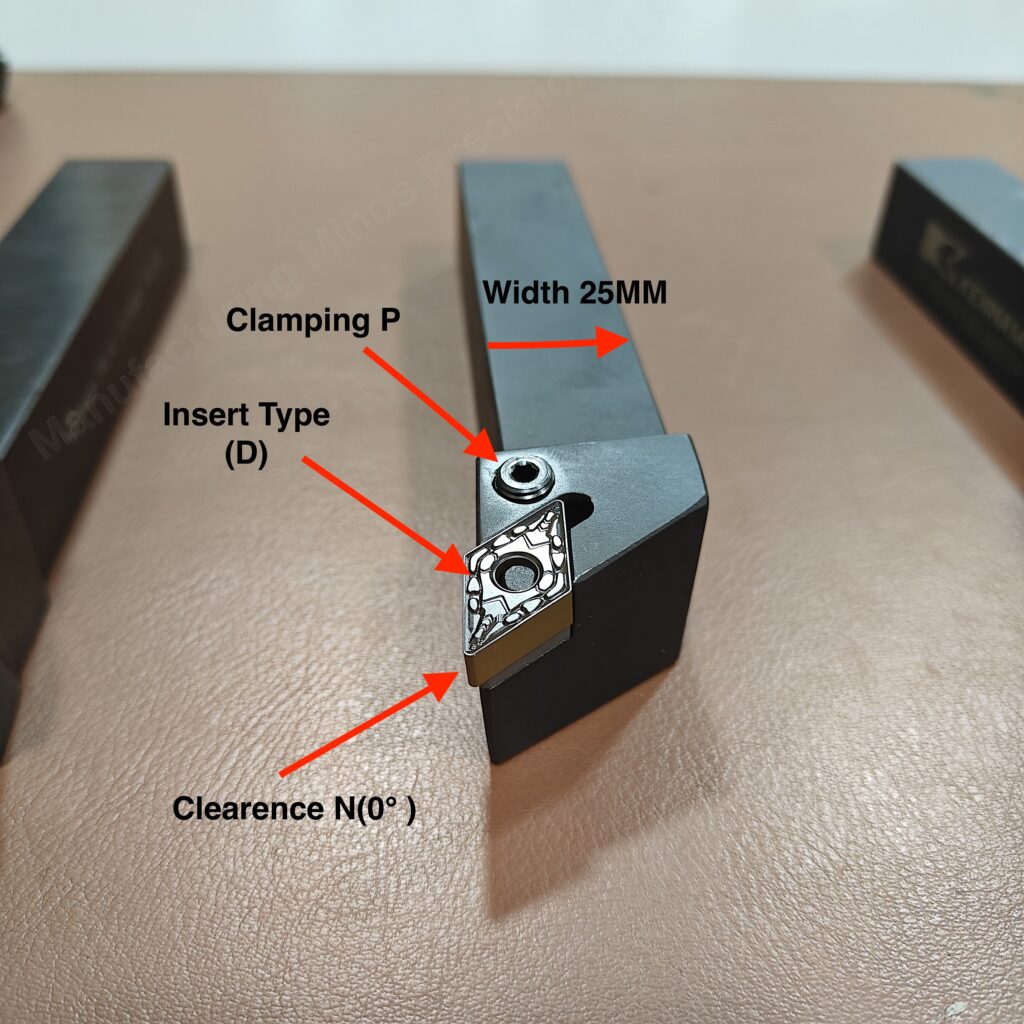
Example 2: PDJNL-2525M15
- P — Hole/lever clamping method — a very secure, easy-to-index clamping style
- D — 55° diamond (rhombic) insert shape
- J — Holder style, roughly a 93° entering angle
- N — 0° insert clearance angle
- L — Left-hand orientation
- 25×25 — Square 25mm shank
- M15 — Length code for this series
What it’s good for: The 55° diamond insert has a sharper point than a trigon or square, which makes this holder well suited to profiling and contour work where you need to get into corners and follow a shaped path. The lever-clamp (P) system is popular because it holds the insert firmly while still being fast to swap out during changeovers.
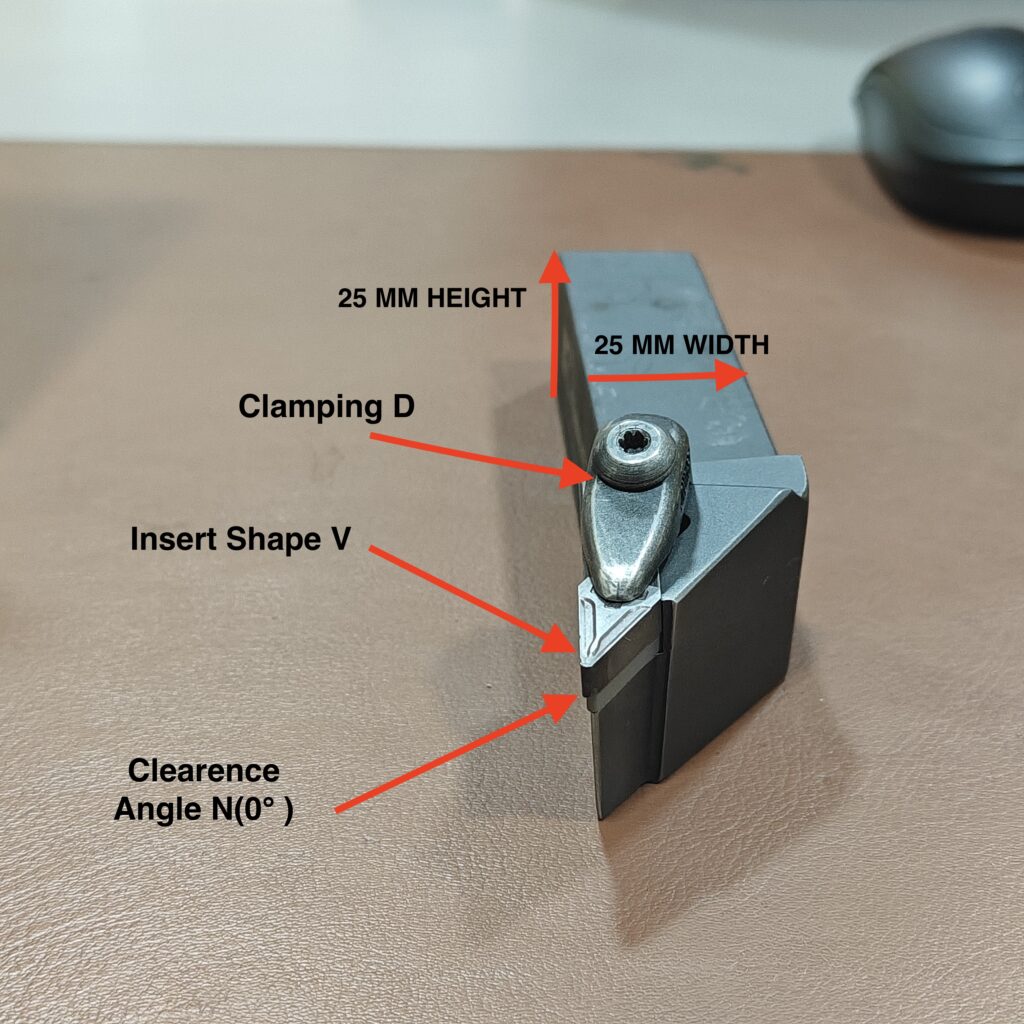
Example 3: DVJNL-2525M16
- D — Screw/wedge clamping method
- V — 35° diamond insert shape — the sharpest, most pointed common insert geometry
- J — Holder style, ~93° entering angle
- N — 0° insert clearance angle
- L — Left-hand orientation
- 25×25 — Square 25mm shank
- M16 — Length code for this series
What it’s good for: The 35° V-shaped insert is the go-to choice when you need to machine into tight corners or copy-turn complex profiles, since its narrow point angle lets it access geometry that a 55° or 80° insert simply can’t reach. The tradeoff is a weaker edge, so it’s better suited to finishing passes than heavy roughing.
How to Choose the Right Tool Holder
With hundreds of ISO codes in circulation, picking the right holder comes down to a handful of practical questions:
1. What’s the entering angle you need? A larger entering angle (like the 95° L-style) spreads cutting force over a longer edge and is more forgiving for roughing. A smaller angle (like a 35° V-insert) is sharper and better for finishing and profile work, but more fragile.
2. Right-hand or left-hand? This depends on your machine’s spindle orientation and which direction the tool needs to feed. Right-hand holders (R) cut moving toward the headstock on most setups; left-hand holders (L) do the opposite. Get this wrong and the insert simply won’t engage the material correctly.
3. What clamping style fits your changeover needs? Lever/hole clamping (P-style) is fast to index and very secure — great for production runs with frequent insert changes. Top-clamp and screw/wedge styles are simpler and often more cost-effective for lower-volume work.
4. Does your shank size match your turret or tool post? A 25×25mm shank is a common mid-size choice for general-purpose lathes, but always confirm against your machine’s tool holding capacity before ordering.
5. Roughing or finishing? Stronger insert shapes (trigon, square, 80° diamond) handle roughing loads better. Sharper shapes (35° and 55° diamonds) are suited to finishing and profiling.
Final Thoughts
The ISO tool holder code looks intimidating the first time you see it, but it’s really just a compact spec sheet — clamping method, insert shape, entering angle, hand, and size, all packed into one string. Once you can read holders like EWLNR-2525M08, PDJNL-2525M15, and DVJNL-2525M16 at a glance, choosing the right holder for a job becomes a lot faster, and you’ll waste less time (and fewer inserts) on trial and error at the machine.
© 2026 Manufacturing Minds Precision LLP. All rights reserved. This content may not be reproduced without permission.